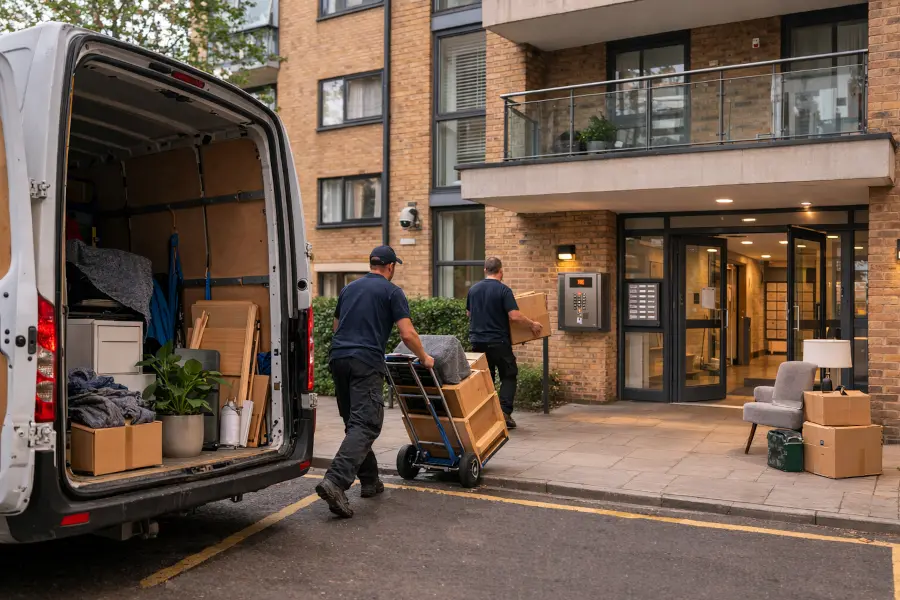
Moving in or out of a London flat can be straightforward. It can also take longer than expected for reasons that have nothing to do with the drive.
The usual sticking points are access-related: a lift that needs booking, a loading bay that is further from the building than it sounds, a long walk through communal areas, or an estate layout that makes unloading slower than it looks on paper.
This guide covers the access issues that most often affect London flat moves, what to check before moving day, and how to avoid booking too tightly. If you need the bigger picture first, start with our moving house in London guide.
Quick check: what could slow your move down?
If more than one of those applies, the move may take longer than a simple postcode-to-postcode estimate suggests.
Why London flat moves often take longer than expected
A house move is often fairly direct. The van arrives, the team loads or unloads, and the main variable is how much needs moving.
Flats and managed buildings are different because there are more steps between the vehicle and the front door. In London, that can mean shared entrances, controlled lifts, loading bays, service corridors, estate roads, gates and internal routes that are less direct than they first appear.
That is why access often shapes the move as much as distance.
Upper-floor moves usually need more loading time. In our recent London move data, they were typically given about 20% more than moves where both addresses were ground floor — a good reminder that access can shape the move just as much as distance.
Two London flats can look similar on paper and still take very different amounts of time if one has direct, simple access and the other involves a booked lift, a longer internal walk or a more awkward unloading point.
What to check with your building before moving day
Some flats are easy to access. Others have building rules or arrangements that affect how the move needs to be done.
Before moving day, check whether your building has anything in place around the following.
Lift bookings
Some buildings let residents use the lift freely. Others want lifts booked in advance, only allow moves in certain hours, or require removals to use a service or goods lift.
Loading bays and unloading points
In many modern developments, removals do not happen from the main entrance. The driver may need to use a loading bay, rear service area or another controlled unloading point.
Service entrances
Some buildings expect moving teams to use a service route rather than the front lobby. That changes both the route and the time needed.
Move-in or move-out windows
You may only be allowed to move during certain hours or on certain days. If the building runs on timed access windows, even a modest delay can create pressure.
Concierge or management procedures
Some buildings want advance notice of removals, driver details or arrival times. In concierge buildings, giving notice early can make the day run more smoothly.
Access arrangements on the day
Check whether the driver will need gate codes, a key fob, entry instructions, a contact number or someone to meet them at a barrier or entrance. Once the date is booked, it is worth doing these checks early rather than leaving them until moving day.
Lift bookings: one of the biggest timing variables
Lift access is one of the most common reasons flat moves take longer than expected.
People often think of it in simple terms: either the building has a lift or it does not. In practice, there is a big difference between a lift being present, usable for a move, large enough, bookable and available during your move window.
Why lifts do not always make things easy
Even where a lift exists, timing can still be affected by waiting for it, sharing it with residents, booking windows, the distance between the lift and the flat, and how easy it is to load larger items in and out.
Our London move data supports the broader point that upper-floor access tends to need more loading time, and a lift does not automatically make that difference disappear.
What to check about the lift
Before moving day, confirm whether the lift needs booking, whether movers can use the normal resident lift, whether there is a service or goods lift, whether larger items will fit, whether there are restrictions on move times, and whether the lift is close to the flat or still leaves a long internal walk.
Loading bays, service entrances and where the move really starts
For many London flat moves, the loading point is not the front door.
People often assume that once the van has arrived, the hard part is done. In reality, the unloading point may be a private loading bay, a rear service entrance, an estate unloading area, a car-park level entrance or a point on site that still involves a walk to the building.
Why this catches people out
A loading bay sounds convenient, but it can still involve a booking process, waiting for the bay to be free, a walk from the bay to the lift or entrance, several doors or controlled access points, and a route through communal or service areas.
What to check
If your building has a loading bay or service entrance, confirm whether it needs booking, what times it can be used, whether there is a time limit, whether someone needs to meet the driver there, how far it is from the unloading point to the flat, and whether there are doors, lift stages or other obstacles in between.
Stairs, corridors and carry distance: what people underestimate most
This is one of the biggest causes of slow-moving flat jobs.
A move can look modest in size and still take longer than expected because each item has further to travel and more obstacles to get through.
Stairs
If there is no lift — or the lift cannot be used for larger items — stairs can slow things down quickly, especially in upper-floor flats, older conversions, split-level properties, buildings with narrow stairwells, and blocks with awkward turns or landings.
Corridors and communal routes
Some modern developments involve long corridors, separate cores or internal routes that add more walking than people expect. Others require the team to move through several shared spaces before they reach the flat itself.
Carry distance
Carry distance is not just about where the van parks on the street. It can also include the walk from the unloading point to the entrance, the route from the entrance to the lift, the route from the lift to the flat, and repeated trips through the same shared route. The longer that route is, the more the move slows down.
Estate layouts and restricted access roads
Estate moves are often less straightforward than they first appear.
Even when unloading is possible on site, the route may still be less direct than expected. Common issues include internal roads that are not especially close to the block, set-down areas that still involve a long walk, gates or barriers, separate vehicle and pedestrian routes, and unloading points that are not beside the entrance residents use most often.
Why estate layouts matter
On an estate, the van may not be able to stop where you assume it can. Or it may be able to stop nearby, but not right outside the part of the building that matters.
What to think about
If either address is on an estate, check where the van can actually stop, whether there are barriers or gates, whether the nearest unloading point matches the entrance you use, whether there is a separate service access route, and whether the driver will need someone to let them through.
Vehicle height limits, basement access and van suitability
Not every access issue is inside the building. Sometimes the vehicle itself is part of the problem.
In London flats and managed developments, common issues include low basement or undercroft clearance, height barriers, tight turning areas, estate roads that are awkward for larger vans, and unloading points that are physically separate from the easiest route into the building.
What to check
If you think access may be restricted, confirm any height limits, whether basement or car-park access is possible, whether all vans can use the unloading area, and whether the driver will need alternative directions or instructions.
Why it is worth allowing extra time
For a very straightforward move, tight timing can sometimes work. For a London flat move with shared-building access, it is often safer to leave a bit more room.
What usually adds time?
If the move is booked with no margin, even a small delay can put pressure on everything else.
That does not mean every flat move needs a large amount of extra time. It does mean that where access is unusual, constrained or simply unclear, allowing some buffer is often the safer option. That is particularly true where one or both properties are above ground floor, since upper-floor access often increases loading time even where a building has a lift.
What to confirm once your moving date is booked
Once the date is fixed, it is worth running through the main access checks as early as possible.
- Have you checked whether the building needs notice of the move?
- If there is a lift, have you confirmed whether it needs booking?
- If there is a loading bay, have you checked whether it needs reserving?
- Do you know which entrance movers should use?
- Have you checked whether there are move-in or move-out time windows?
- Have you checked whether the van can reach the intended unloading point?
- Have you checked whether height limits or barriers apply?
- Do you know whether the route from the unloading point to the flat is long or awkward?
- Do you have the right contact details for access issues on the day?
- Have you flagged anything unusual to the driver?
These checks are much easier to deal with before the day than during it.
What to tell your driver before moving day
This is one of the simplest ways to avoid surprises.
Basic booking details can cover the essentials, but they do not always show the full picture where access is more complicated. If your move involves lifts, loading bays, long carries, estate barriers or unusual building rules, it is worth contacting your driver directly beforehand and explaining it clearly. It can also help you sense-check whether the time you have booked feels realistic for the access involved.
Use this as a brief-your-driver template
Collection address access
Floor:
Lift available:
Lift booking needed:
Stairs:
Long corridor or awkward route:
Loading bay or service entrance:
Carry distance from van to entrance:
Concierge / access instructions:
Height or vehicle restrictions:
Delivery address access
Floor:
Lift available:
Lift booking needed:
Stairs:
Long corridor or awkward route:
Loading bay or service entrance:
Carry distance from van to entrance:
Concierge / access instructions:
Height or vehicle restrictions:
Any move window restrictions:
Any access times:
Anything else likely to slow loading or unloading:
The clearer the access picture, the easier it is to plan realistic timing and reduce the chances of last-minute surprises. That matters most where the move is tightly timed, the building is managed, the route is indirect or the unloading point is not obvious.
London building types and what usually catches people out
In London, access problems often depend as much on the type of building as the floor you are on.
| Building type | What often catches people out | What to check early |
|---|---|---|
| Older conversion | No lift, narrow stairs, awkward corners and limited shared space | Whether larger items fit the route and how much stair carrying is involved |
| Mansion block / older purpose-built flat | Heavy communal doors, tighter stair cores and longer internal routes | The full route from van to flat, not just the floor number |
| Estate block | Less obvious unloading points, internal roads, barriers and extra walking | Where the van can actually stop and whether the driver needs help getting in |
| Modern development / concierge building | Booked lift windows, loading-bay procedures and service-entrance rules | What must be booked, what details the building needs, and how the unload route works |
Final thought: plan the access, not just the journey
For London flat moves, the most useful question is not just how far you are travelling. It is how easy it is to get from the van to the property at both ends. If you check that properly, allow for the real access conditions and let your driver know about anything unusual in advance, you are much more likely to book enough time and avoid unnecessary pressure on moving day.
FAQs About London Flats, Estates & Access Logistics
About Compare The Man and Van
Compare The Man and Van helps people compare quotes from vetted, fully insured man and van drivers across London and the UK.
Our London moving guides are written by our in-house team using insight from real bookings, so the advice reflects the kinds of access, parking, loading and pricing issues that come up on actual moves.
When you compare quotes with us, you can see live prices from trusted local drivers and choose a mover that fits your move, your budget and the level of help you need.
Ready to compare London move quotes?
Once you know your lift, loading bay and access details, it becomes much easier to judge the right amount of time, compare quotes properly and avoid unnecessary pressure on moving day.
Compare London man and van quotes


