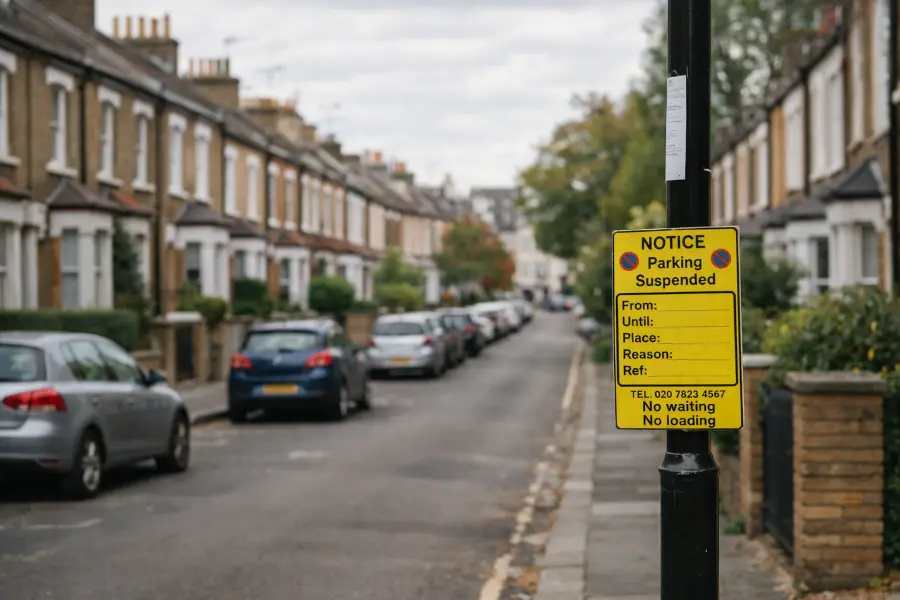
Not every London move needs formal parking permission. Some can rely on legal loading or private stopping arrangements. Others are much easier, safer and less stressful when the space is planned properly in advance.
The real question is not simply whether you can get a suspension. It is whether the move can work reliably without one.
That usually depends on four things: the street itself, how long the van is likely to need to stay, how easy the property is to access, and whether the road is managed by the borough or by Transport for London (TfL).
This guide helps you work out when legal loading may be enough, when a suspension is worth arranging, when a dispensation may be the better fit, and when the normal borough route may not apply at all. For the wider planning picture, start with our guide to moving house in London.
Quick answer: what kind of parking setup might your move need?
Which applies to your move?
Do You Actually Need Formal Parking Permission?
Usually, the honest answer is: sometimes, but not always.
Many London moves can go ahead without a suspension or dispensation, especially where access is simple and the van can stop lawfully without needing space reserved. Once the street is tighter, the move is slower, or the stopping arrangement is uncertain, formal permission becomes much more relevant.
You may not need formal permission if stopping is straightforward
Some moves are simple enough that formal permission is unnecessary. That is often the case where:
- there is a private driveway or forecourt
- the building has a private loading area already arranged
- stopping space is obvious and workable
- the move is small and the loading time is likely to be short
In those cases, the main job is usually to sense-check the plan rather than start an application process.
Legal loading may be enough in some cases
On some London streets, legal loading is enough. That is more likely where:
- the volume of items is manageable
- the stop is unlikely to run on for long
- there is suitable legal stopping space nearby
- there is no clear need to reserve a bay in advance
If that sounds like your move, check the street-side rules first rather than assume you need a suspension. Our guide to CPZ, yellow lines and loading rules in London explains that side in more detail.
A suspension may be worth arranging if space needs to be kept free
A parking suspension becomes more useful when the real issue is not just legality, but certainty.
- the move is likely to take longer
- the street is busy and a legal space may not be free when you need it
- the frontage relies on resident or shared-use bays
- the van needs to stop very close to the property for the move to work properly
In those situations, reserving space can make the move much more predictable on the day.
A dispensation or TfL route may apply instead
Not every restricted stopping situation is solved by a suspension.
Sometimes the van needs permission to stop where restrictions would normally apply, rather than a bay being reserved. In other cases, especially where the road is TfL-managed or the property is on a red route, the normal borough route is simply not the right one.
If your move involves a red route, see our guide to red routes and moving house in London.
Suspension, Dispensation or Legal Loading: What’s the Difference?
These terms are often blurred together, but they do different jobs. Getting the distinction right makes the rest of the planning much easier.
| Option | Best for | Main purpose | Who usually manages it |
|---|---|---|---|
| Legal loading | Short, straightforward moves with workable legal stopping | Rely on normal loading rules | Depends on the road and restrictions |
| Parking suspension | When you need a bay or stretch of road kept clear | Reserve space for the move | Usually the borough council |
| Dispensation | When you need permission to stop where restrictions would normally apply | Allow stopping in restricted circumstances | Usually the borough council, subject to local rules |
| TfL / red-route route | When the frontage is on a red route or TfL-managed road | Follow the correct non-borough route | TfL |
Parking suspension
A parking suspension usually means a bay, or part of a bay, is temporarily taken out of normal use so the space can be kept available for your move.
This is most common where the frontage relies on resident permit bays, shared-use bays, pay-and-display space or other marked on-street bays that would otherwise still be in use.
The point of a suspension is not to change the whole road. It is simply to keep the space you need clear.
Dispensation
A dispensation is different. It usually means permission is given for the van to stop or park where restrictions would normally prevent it, rather than a bay being reserved in the usual way.
That is why suspensions and dispensations should not be treated as interchangeable. One is mainly about keeping space free. The other is more about allowing a restricted stop to take place.
Availability varies between boroughs, so when you need the local route, use the borough parking permissions directory.
Legal loading without formal permission
Sometimes no formal permission is needed at all.
If the stop will be short, the street arrangement is workable, and loading is lawfully allowed, normal loading may be enough. That is often the simplest route where the move is relatively small and access is easy.
If you need to work out whether loading is realistic on your street, go to our CPZ, yellow lines and loading rules guide.
Red routes are separate
Red routes should be treated as their own case. If the road is TfL-managed, the borough route may not apply in the way you expect. That is why red-route moves should be handled separately rather than folded into normal suspension logic.
When a Parking Suspension Is Usually Worth It
A suspension is most useful when the move depends on having space available at a specific point, at a specific time, and relying on chance would be too risky.
Longer moves
The longer the move is likely to take, the less practical it becomes to rely on ordinary on-street luck.
- there is a larger volume of furniture and boxes
- multiple trips in and out are likely
- loading and unloading will naturally take time
- the job cannot realistically be done in a quick stop
The longer the van needs to stay close by, the more valuable reserved space becomes.
Difficult access
A move that looks simple on paper can still need a suspension because access makes it slower in practice.
- an upper-floor property
- a longer carry distance
- a managed building
- booked lift access
- awkward movement between the entrance and the vehicle
If access is likely to slow the move down, reserved space becomes more important. Our guide to London flats, estates and access logistics covers that side in more detail.
Busy residential streets
Some streets are simply poor candidates for relying on chance. That is especially true where the frontage is made up of resident permit bays, shared-use bays, heavily used kerbside space, or streets where a legal space may not be free when the van arrives.
In those situations, a suspension is often less about paperwork and more about avoiding moving-day uncertainty.
Bulky or awkward items
A move involving heavier or bulkier items usually needs more control over the stopping setup.
- sofas
- wardrobes
- appliances
- heavier furniture that is slower to handle safely
The more awkward the load, the less practical it becomes to work from an unreliable stopping arrangement.
How the Application Process Usually Works
The detail varies, but the practical sequence is usually similar.
Check who manages the road
Before anything else, confirm whether the road is borough-managed or TfL-managed.
That single check often determines the right route from the start. If the frontage is on a red route or another TfL-managed section, the borough process may not solve the problem.
Confirm what kind of permission is available
Once you know who manages the road, the next step is to work out what kind of permission actually exists for that location:
- A suspension
- A dispensation
- Another local process depending on the borough
- A TfL-specific route for red routes
If you need borough-specific next steps, use the borough parking permissions directory.
Apply with enough notice
If formal permission is needed, timing matters.
Short notice does not just create pressure. It can reduce your options altogether. Some councils require several working days. Others need longer. The safest approach is to start checking as soon as the moving date is agreed, rather than leave it until the week of the move.
Make sure the permission window matches the move
Permission is only useful if it actually fits the move itself:
- The approved time window needs to line up with the expected van arrival
- The booking duration needs to make sense for the size and complexity of the move
- Building-side arrangements still need to work with the street-side setup
If the move involves a red route, use our red routes guide rather than assume the borough route applies.
How much notice do you usually need?
Notice periods vary, so there is no single London-wide answer.
As a practical rule:
- Most boroughs need at least 5-7 day working days
- Many ask for 10 or more
- Short-notice applications are less flexible and tend to be more expensive
- Busier streets and more complex moves are usually better handled earlier
The safest habit is to treat the parking side as something to check as soon as the moving date is confirmed, not after everything else has already been booked.
If you want the local picture, use the borough parking permissions directory.
Don’t leave this until the last minute
Once your moving date is confirmed, check the road and the likely application route early. Even when the move itself is simple, the permission process may not be.
Typical Costs and What Affects Them
Costs vary, but it helps to understand what you may actually be paying for — and why a lower upfront parking cost does not always mean an easier or cheaper move overall.
What you may be paying for
- an admin fee
- one or more bays
- a set duration
- signage or setup arrangements
This is why the final amount can vary even between moves that look similar on paper.
What usually pushes the cost up
Parking-related costs tend to rise when the request is more involved.
- more than one bay is needed
- the booking needs to run for longer
- the street setup is more complex
- the request is being arranged at shorter notice
- the local authority’s charging structure is less straightforward
One of the easiest mistakes is assuming a friend’s suspension cost in one borough will be a good guide for another move elsewhere in London. The road layout, authority, bay type, duration and notice period can all change the picture.
Why this is not just about the fee itself
The permission fee may be only one part of the decision.
Skipping the parking fee can look cheaper at first, but it may create bigger problems elsewhere if the van cannot stop close enough or the move takes longer than expected. That is why this is not just about what the council charges. It is also about how much risk and friction the arrangement removes.
When the fee is usually worth it
A suspension or similar permission tends to feel most worthwhile when the move is long enough, awkward enough or time-sensitive enough that losing the space would create a bigger problem than the charge itself.
If the whole job depends on the van being close to the property, parking is usually better treated as part of the move plan, not an optional extra.
Why this still sits inside the wider move budget
The parking side matters, but it is still only one part of the overall cost picture. For the wider budget view — including labour, van size, timing and access-related costs — see our guide to London moving costs.
Red Routes and TfL-Managed Roads
This is the main exception to normal borough parking logic.
If the frontage is on a red route or another TfL-managed road, do not assume the borough suspension process is the right answer. In those cases, you need to work from the TfL side instead.
- borough parking guidance may not solve the problem
- the correct authority still needs to be identified first
- if the move depends on a red-route frontage, use the red routes guide
When You May Not Need Formal Permission
Not every move needs a suspension or dispensation.
- there is a private driveway or forecourt
- legal stopping is obvious and workable
- the move is small and access is straightforward
- the building already has a private or pre-arranged loading area
If that sounds more like your move, the better next step may be checking the kerbside rules rather than moving straight into an application process. Start with our guide to CPZ, yellow lines and loading rules in London.
If the property is a flat or managed building, it is also worth checking the building-side access separately in our guide to flats, estates and access logistics.
What to do once your moving date is confirmed
Once the date is fixed, work through the parking side in this order:
- identify who manages the road
- check whether legal loading is realistically enough
- decide whether the move needs a suspension, a dispensation or a different route
- apply early if formal permission is needed
- confirm access arrangements at the property separately
- make sure the permission window matches the planned move time
If you need borough-specific next steps, use the borough parking permissions directory. If access is likely to slow things down, check flats, estates and access logistics.
Once the parking and access side is clear, you can compare vetted London man and van quotes with a much better sense of what the move actually needs.
FAQs About Parking Permits, Suspensions & Dispensations in London
About Compare The Man and Van
Compare The Man and Van helps people compare quotes from vetted, fully insured man and van drivers across London and the UK.
Our London moving guides are written by our in-house team using insight from real bookings, so the advice reflects the kinds of access, parking, loading and pricing issues that come up on actual moves.
When you compare quotes with us, you can see live prices from trusted local drivers and choose a mover that fits your move, your budget and the level of help you need.
Ready to compare London quotes?
Once you know whether your move can rely on legal loading or needs formal parking permission, it becomes much easier to compare quotes properly and choose the right level of help.
Compare London man and van quotes


